A 71 year old male
A 71 year old male patient is brought into the emergency department with urosepsis. It is decided to intubate him pending transfer to ITU. Your consultant requests you prepare propafol and suxamthonium for rapid sequence intubation (RSI). What is the recommended dose of suxamethonium for RSI in adults?
The correct dose of suxamethonium for RSI in adults is 1-1.5 mg/kg
The correct dose of suxamethonium for RSI in adults is 1-1.5 mg/kgAirway management: Rapid sequence induction (RSI)
Rapid sequence induction (RSI)
RSI is one method of placing an endotracheal tube (ETT). RSI is designed to minimise the time delay between loss of protective airway reflexes and placement of an ETT in the trachea.
RSI Steps
RSI involves inducing loss of consciousness whilst cricoid pressure is applied followed by intubation without face mask ventilation.
The sequence of steps in RSI can be remembered by the 7P's:
Step 1: Preparation
This step involves preparing the following:
Step 2: Pre-oxygenation
Optimal pre-oxygenation ensures the patient has an adequate oxygen reserve and prolongs the time before desaturation in the event of apnoea during RSI.
Breathing 100% for 3 minutes is typically sufficient. An end tidal O2 > 85% is the target. CPAP/NIV may be used if the patient is not adequately oxygenated using supplemental oxygen via standard face mask.
Nasal cannula used during procedure.
Step 3: Pre-treatment
Drugs may be administered to counter some of the expected side effects of the procedure and anaesthetic agents used. These include:
Step 4: Paralysis and induction
A rapid acting induction agent is administered followed by a neuromuscular blocking (paralysing) agent. Commonly used agents are shown in the table below.
Note Suxamethonium is the only depolarising neuromuscular blocker.
Step 5: Protection and positioning
Cricoid Pressure
Following administration of the induction agent, the patient will stop breathing and lose protective airway reflexes. As this happens 30-40N of force should be applied to the cricoid cartilage to prevent regurgitation of gastric contents which may be aspirated. cricoid pressure is only released after the ETT has been passed and cuff inflated.
Neck position
If there is concern regarding C-spine injury in line stabilisation should be used. If C-spine injury is not suspected a small pillow may be placed under the neck allowing the neck to be extended.
Step 6: Placement & proof
Following administration of the NWB the intubator should wait 45-60 seconds before passing the ETT. Intubation in most UK centres is now done using video laryngoscopy
Tube position is confirmed by a combination of:
Once the intubator is satisfied with the tube position, has inflated the cuff and secured the ETT he/she will the instruct the team member applying Cricoid pressure to discontinue.
If intubation fails then the patient should be oxygenated pending a further attempt or moving to plans B, C or D. See the diagram.
Step 7: Post-intubation management
Standard post intubation care involves the following:
RSI is one method of placing an endotracheal tube (ETT). RSI is designed to minimise the time delay between loss of protective airway reflexes and placement of an ETT in the trachea.
Main benefit of RSI
Minimises the risk of aspiration in patients who are not adequately fasted or those at higher risk of aspiration due to other causes such as impaired gastric emptying and gastric reflux.
Minimises the risk of aspiration in patients who are not adequately fasted or those at higher risk of aspiration due to other causes such as impaired gastric emptying and gastric reflux.
RSI Steps
RSI involves inducing loss of consciousness whilst cricoid pressure is applied followed by intubation without face mask ventilation.
The sequence of steps in RSI can be remembered by the 7P's:
The 7 P's:
1. Preparation
2. Pre-oxygenation
3. Pre-treatment
4. Paralysis and induction
5. Protection and positioning
6. Placement with proof
7. Post-intubation management
1. Preparation
2. Pre-oxygenation
3. Pre-treatment
4. Paralysis and induction
5. Protection and positioning
6. Placement with proof
7. Post-intubation management
Step 1: Preparation
This step involves preparing the following:
- Prepare the patient
- Prepare the equipment
- Prepare the team
- Prepare for difficulty
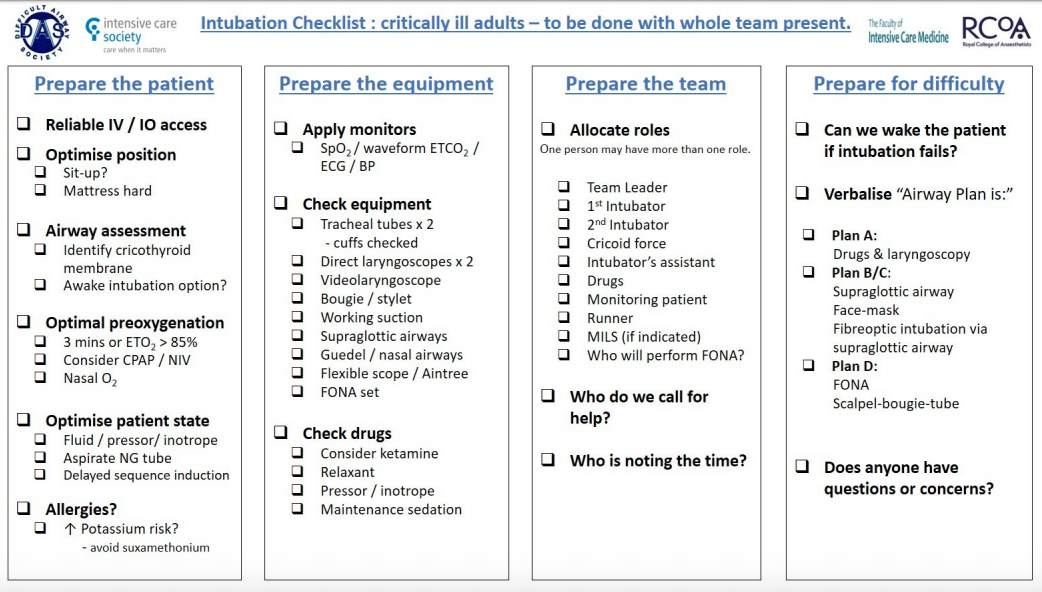 | |
RCOA intubation checklist. Click on image to enlarge
Step 2: Pre-oxygenation
Optimal pre-oxygenation ensures the patient has an adequate oxygen reserve and prolongs the time before desaturation in the event of apnoea during RSI.
Breathing 100% for 3 minutes is typically sufficient. An end tidal O2 > 85% is the target. CPAP/NIV may be used if the patient is not adequately oxygenated using supplemental oxygen via standard face mask.
Nasal cannula used during procedure.
Step 3: Pre-treatment
Drugs may be administered to counter some of the expected side effects of the procedure and anaesthetic agents used. These include:
| Drug | Reason for administration |
|---|---|
| Lidocaine |
|
| Opiates (Fentanyl) | Fentanyl attenuates the catecholamine surge in RSRL which provides:
|
| Atropine | Prevents bradycardia |
| IV fluid bolus | Mitigates hypotension |
Step 4: Paralysis and induction
A rapid acting induction agent is administered followed by a neuromuscular blocking (paralysing) agent. Commonly used agents are shown in the table below.
Note Suxamethonium is the only depolarising neuromuscular blocker.
| Induction agents | Depolarizing Neuromuscular blockers (NMB) | Non-depolarizing Neuromuscular blockers (NMB) |
|---|---|---|
| Propofol 1% Ketamine Thiopentone Etomidate | Suxamethonium | Rocuronium (non-depolarising) Atracurium (non-depolarising) Vecuronium (non-depolarising) |
| NMB | Type | Dose in RSI | Time to induce paralysis | Time to recover spontaneous breaths |
|---|---|---|---|---|
| Suxamethonium | depolarising | 1.5 mg/kg | 45-60 seconds | 8-10 minutes |
| Rocuronium | non-depolarising | 1 mg/kg | 45-60 seconds | 20-25 minutes |
Neuromuscular blocking agents (NMB's) act on the neuromuscular junction.
Depolarizing muscle relaxants bind to acetylcholine (ACh) receptors and act as agonists. Suxamethonium (also known as succinylcholine) is the only depolarizing NMB in clinical use. It binds to the ACh receptors and generates an action potential. Unlike acetylcholine it is not metabolised by acetylcholinesterase resulting in prolonged binding time and extended depolarization of the muscle end-plate as the end plate cannot repolarize. This is termed phase I block. Under normal circumstances it is eventually metabolised by plasma cholinesterase (previously called pseudocholinesterase). When Suxamethonium is used there are muscle fasciculations followed by paralysis.
The ACh receptor can also undergo conformational and ionic changes after a prolonged period of depolarisation resulting in an undesirable phase II block.
Non-depolarizing muscle relaxants act as competitive antagonists. They bind to the ACh receptors but do not induce ion channel openings. They prevent ACh from binding and thus end plate potentials do not develop. As non-depolarazing NMB's do not act as receptor agonists there are no fasciculations prior to paralysis.
Depolarizing muscle relaxants bind to acetylcholine (ACh) receptors and act as agonists. Suxamethonium (also known as succinylcholine) is the only depolarizing NMB in clinical use. It binds to the ACh receptors and generates an action potential. Unlike acetylcholine it is not metabolised by acetylcholinesterase resulting in prolonged binding time and extended depolarization of the muscle end-plate as the end plate cannot repolarize. This is termed phase I block. Under normal circumstances it is eventually metabolised by plasma cholinesterase (previously called pseudocholinesterase). When Suxamethonium is used there are muscle fasciculations followed by paralysis.
The ACh receptor can also undergo conformational and ionic changes after a prolonged period of depolarisation resulting in an undesirable phase II block.
Non-depolarizing muscle relaxants act as competitive antagonists. They bind to the ACh receptors but do not induce ion channel openings. They prevent ACh from binding and thus end plate potentials do not develop. As non-depolarazing NMB's do not act as receptor agonists there are no fasciculations prior to paralysis.
Step 5: Protection and positioning
Cricoid Pressure
Following administration of the induction agent, the patient will stop breathing and lose protective airway reflexes. As this happens 30-40N of force should be applied to the cricoid cartilage to prevent regurgitation of gastric contents which may be aspirated. cricoid pressure is only released after the ETT has been passed and cuff inflated.
Neck position
If there is concern regarding C-spine injury in line stabilisation should be used. If C-spine injury is not suspected a small pillow may be placed under the neck allowing the neck to be extended.
Step 6: Placement & proof
Following administration of the NWB the intubator should wait 45-60 seconds before passing the ETT. Intubation in most UK centres is now done using video laryngoscopy
Tube position is confirmed by a combination of:
- Visualisation of the tube passing between the vocal cords
- Auscultation of both sides of the chest and over the stomach
- End-tidal CO2 measurement (most reliable method)
- Visualise misting of tube
Once the intubator is satisfied with the tube position, has inflated the cuff and secured the ETT he/she will the instruct the team member applying Cricoid pressure to discontinue.
If intubation fails then the patient should be oxygenated pending a further attempt or moving to plans B, C or D. See the diagram.
Step 7: Post-intubation management
Standard post intubation care involves the following:
- ECG
- SpO2
- NIBP / A-Line
- Capnograph
- Naso / Oro Gastric tube
- Urinary Catheter
- CXR
- Arterial Blood Gas
- Maintenance sedation and NMB
Minimum monitoring requirements for patients during anaesthetia following RSI
Minimum monitoring requirements for patients recovering from anaesthetia or deep sedation
- Pulse oximeter
- NIBP
- ECG
- Inspired and expired oxygen, carbon dioxide, nitrous oxide and volatile anaesthetic agent if used
- Airway pressure
- Peripheral nerve stimulator when neuromuscular blocking drugs used
- Temperature in procedures > 30 min duration
Minimum monitoring requirements for patients recovering from anaesthetia or deep sedation
- Pulse oximeter
- NIBP
- ECG
- Capnography if the patient has a tracheal tube, supraglottic airway device in situ or is deeply sedated
- Temperature
Textbooks
Links
| BJA | 10 |
| Aspiration under anaesthesia: risk assessment and decision-making | |
| Difficult airway society | 00 |
| Intubation guidelines | |
| NHS Scotland | 00 |
| Rapid Sequence Intubation | |
| AAGBI | 00 |
| Standards of monitoring during anaesthesia and recovery | |
| LITFL | 00 |
| RSI | |
| BJA | 00 |
| Pharmacology of neuromuscular blocking drugs | |
| RCOA | 01 |
| Guidelines for the Provision of Anaesthesia Services in the Non-theatre Environment 2020 | |
| RCEM Learning | 01 |
| RSI | |
Media
 | |
| Video laryngoscopy | |
| Teleflex - YouTube | 10 |
Score: 100%
| 1 |


Comments
Post a Comment