5 year old female
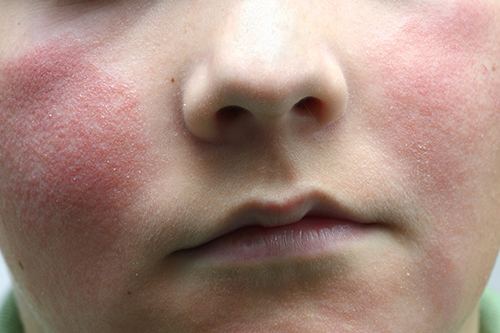
5 year old female is brought to the emergency department by her concerned mother who has noticed the patients cheeks have become bright red (shown below). The patient is otherwise well in themselves.
 | |
What is the likely causative organism?
Parvovirus B19 is the causative organism in erythema infectiosum (slapped cheek syndrome)
Parvovirus B19 causes 'slapped cheek syndrome' otherwise known as erythema infectiosum or fifth disease. It is usually a mild illness.Parvovirus B19 & Erythema infectiosum
Parvovirus B19 is a DNA virus which causes a variety of clinical presentations. It was identified in the 1980's as the cause of erythema infectiosum
Presentations of Parvovirus B19
Erythema infectiosum (also known as fifth disease or 'slapped-cheek syndrome')
Many childhood infections result in rashes. The table below summarises the main characteristics of common and significant childhood infections:
Presentations of Parvovirus B19
- Erythema infectiosum (most common presenting illness of Parvovirus B19)
- Asymptomatic
- Pancytopaenia in immunosuppressed patients
- Aplastic crises e.g. in sickle-cell disease (parvovirus B19 suppresses erythropoiesis for about a week so aplastic anaemia is rare unless there is a chronic haemolytic anaemia)
Erythema infectiosum (also known as fifth disease or 'slapped-cheek syndrome')
- Usually mild illness that starts around 7 days after exposure
- Prodromal illness of fever, rhinitis, sore throat and headache last for 2-3 days and occur 7-10 days prior to onset of rash. Arthralgia may occur in adults
- After a 7 day asymptomatic period the facial rash appears. The facial rash appears as bright erythema to one or both cheeks sparing the nose, perioral and periorbital regions. This rash typically resolves within 2-4 days.
- 1-4 days after the appearance of the facial rash, a macular/morbilliform rash develops on the extremities, usually on the extensor surfaces which may spread to the trunk. The morbilliform rash typically fades within 3 days to 3 weeks but may persist for up to 6 weeks and may recur in reaction to certain stimuli such as heat and sunlight.
| |
The 'slapped cheek' appearance of a patient with Parvovirus B19. The rash is usually not painful but often reported as feeling hot. Click on image to enlarge
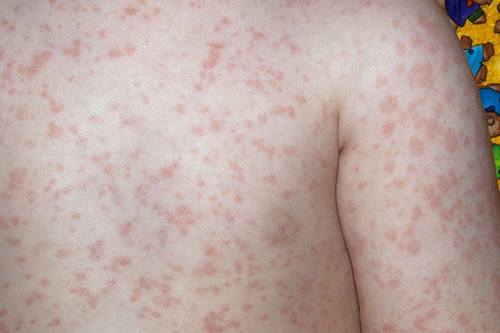 | |
The morbilliform rash seen following the facial rash in a patient with Parvovirus B19. Click on image to enlarge
Erythema infectiosum Infectivity and transmission
- Transmission is usually via respiratory secretions
- Incubation period for clinical erythema infectiosum is 4-20 days before the rash develops.
- Patients are infective from 10 days pre-rash until the onset of the rash
- Patients are no longer infectious once the rash appears
- Infection typically confers lifelong immunity
Many childhood infections result in rashes. The table below summarises the main characteristics of common and significant childhood infections:
| Infection | Features |
|---|---|
| Chickenpox | Fever initially Itchy, rash starting on head/trunk before spreading. Initially macular then papular then vesicular Systemic upset is usually mild |
| Measles | Prodrome: irritable, conjunctivitis, fever Koplik spots: white spots ('grain of salt') on buccal mucosa Rash: starts behind ears then to whole body, discrete maculopapular rash becoming blotchy & confluent |
| Mumps | Fever, malaise, muscular pain Parotitis ('earache', 'pain on eating'): unilateral initially then becomes bilateral in 70% |
| Rubella | Rash: pink maculopapular, initially on face before spreading to whole body, usually fades by the 3-5 day Lymphadenopathy: suboccipital and postauricular |
| Erythema infectiosum | Also known as fifth disease or 'slapped-cheek syndrome' Caused by parvovirus B19 Lethargy, fever, headache 'Slapped-cheek' rash spreading to proximal arms and extensor surfaces |
| Scarlet fever | Reaction to erythrogenic toxins produced by Group A haemolytic streptococci Fever, malaise, tonsillitis 'Strawberry' tongue Rash - fine punctate erythema sparing face |
| Hand, foot and mouth disease | Caused by the coxsackie A16 virus Mild systemic upset: sore throat, fever Vesicles in the mouth and on the palms and soles of the feet |
Textbooks
Score: 50%
| 1 | ||
| 2 |


Comments
Post a Comment