A 55 year old male
A 55 year old male presents to the emergency department complaining of palpitations and shortness of breath. He tells you it started around 1 hour ago shortly after finishing a round of golf. The patient tells you he is asthmatic and takes two inhalers but this does not feel like an asthma attack. His observations are shown below:
| Parameter | Result |
| Blood pressure | 108/68 mmHg |
| Pulse rate | 158 bpm |
| Respiration rate | 16 rpm |
| SpO2 | 95% on air |
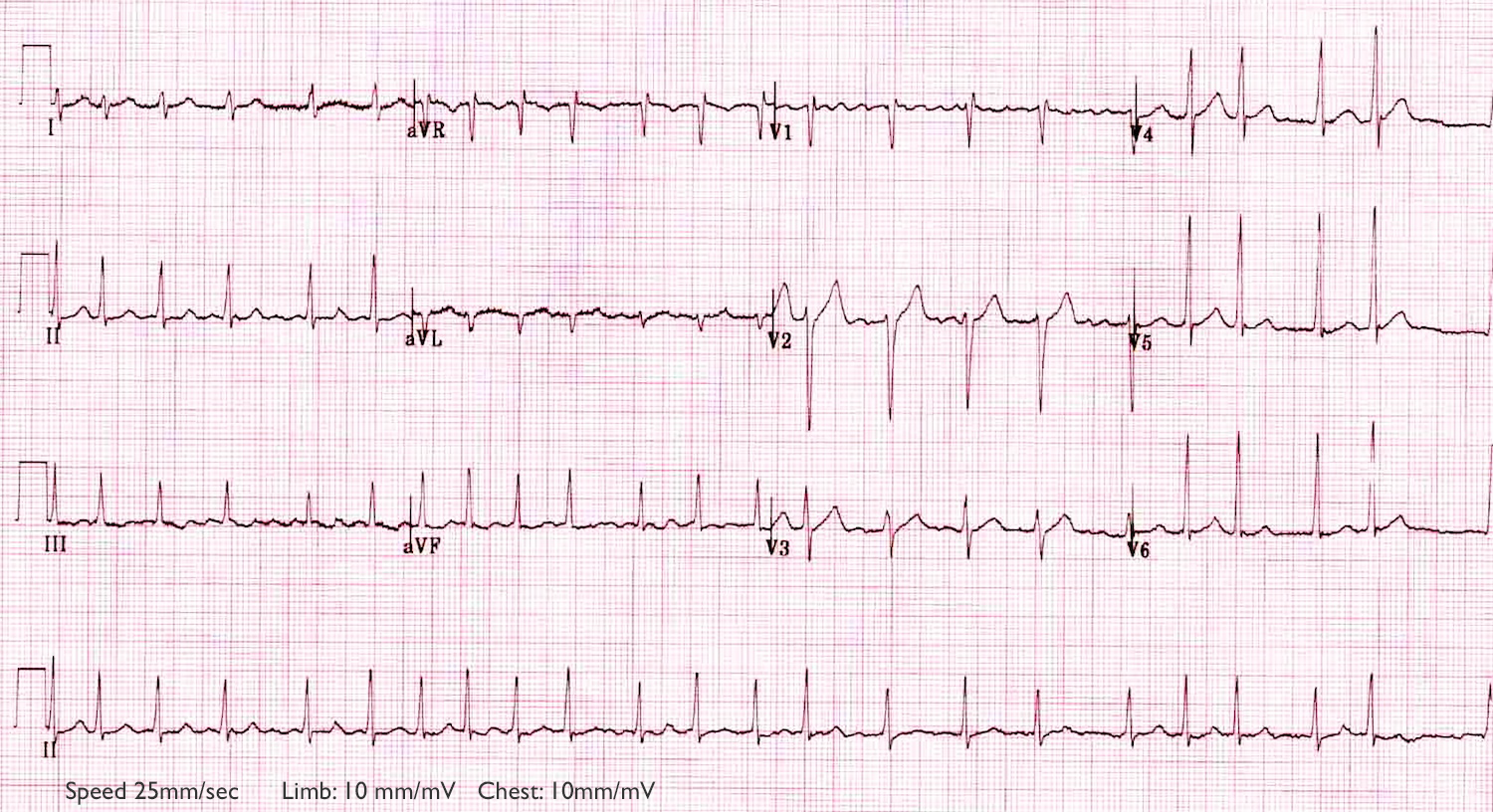
The patient is given supplemental oxygen and IV access is obtained. An ECG is obtained which is shown below:
 | |
What initial drug treatment would be most appropriate for this patient?
Rate control of patient's in AF should be achieved using a beta-blocker (other than Sotalol) or a rate limiting calcium channel blocker
This patient has fast atrial fibrillation (AF). In patients who are suitable for a pharmacological management strategy rate control with a beta-blocker (other than Sotalol) or a rate limiting calcium channel blocker is advised by NICE and the resus council. This patient has a history of asthma which is a contraindication to beta-blocker therapy. Digoxin and Amiodarone are alternatives. NICE advise Digoxin is reserved for those with sedentary lifestyles.Peri-arrest arrhythmia's: tachycardia
Tachycardia classification
Tachycardia may be broadly classified as narrow-complex or broad complex depending on the duration of the QRS complex.
The classification allows the clinician to follow the appropriate pathway of the peri-arrest algorithm (shown below).
Synchronised DC shocking for unstable patients
It is important to note that regardless of broad or narrow complex classification that unstable patients (those showing any of the adverse features listed below ) presenting with a tachycardia with a pulse should receive synchronised DC shock as first line treatment
Tachycardia with a pulse algorithm
Atrial Fibrillation
The patient with AF will also need to be considered for anticoagulation once the tachycardia has been controlled.
Anticoagulation may be achieved using one of the following drugs:
Patients should be assessed for future VTE and bleeding risk using the CHA2DS2VASc and HAS-BLED scores (see below)
CHA2DS2VASc score
HAS-BLED score
Tachycardia may be broadly classified as narrow-complex or broad complex depending on the duration of the QRS complex.
Classification
QRS less than 0.12 seconds (3 small squares on ECG) is narrow complex
QRS greater than 0.12 seconds (3 small squares on ECG) is broad complex
QRS less than 0.12 seconds (3 small squares on ECG) is narrow complex
QRS greater than 0.12 seconds (3 small squares on ECG) is broad complex
The classification allows the clinician to follow the appropriate pathway of the peri-arrest algorithm (shown below).
Synchronised DC shocking for unstable patients
It is important to note that regardless of broad or narrow complex classification that unstable patients (those showing any of the adverse features listed below ) presenting with a tachycardia with a pulse should receive synchronised DC shock as first line treatment
Adverse features indicating need for synchronised DC shock:
Adverse features:
Adverse features:
- Shock
- Syncope
- Myocardial ischaemia
- Heart failure
Tachycardia with a pulse algorithm
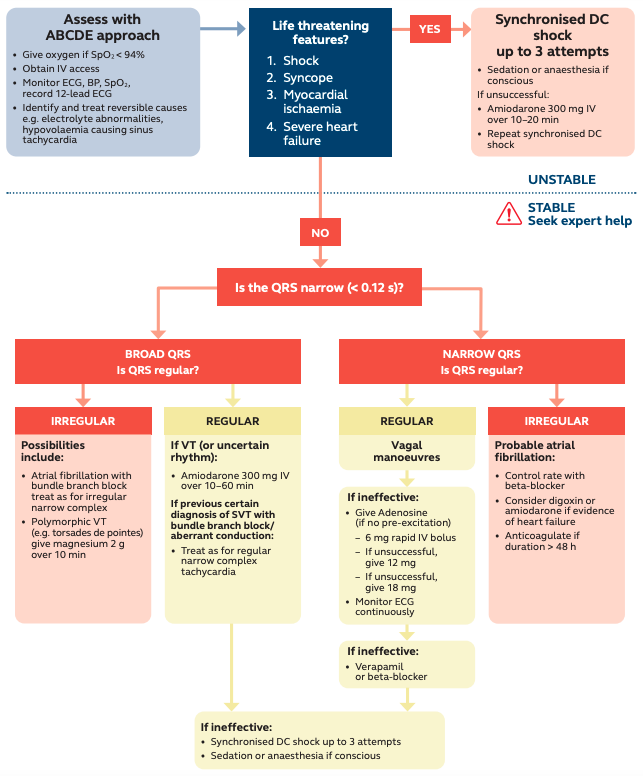 | |
The 2021 resuscitation council algorithm for treatment of tachycardia with a pulse click on image to enlarge
Atrial Fibrillation
The patient with AF will also need to be considered for anticoagulation once the tachycardia has been controlled.
Anticoagulation may be achieved using one of the following drugs:
- Apixaban
- Dabigatran etexilate,
- Rivaroxaban
- Warfarin
Patients should be assessed for future VTE and bleeding risk using the CHA2DS2VASc and HAS-BLED scores (see below)
CHA2DS2VASc score
| Condition | Score | |
|---|---|---|
| C | Congestive heart failure/left ventricular dysfunction (heart failure with reduced ejection fraction, or people with recent decompensated heart failure requiring hospitalization, irrespective of ejection fraction) | 1 |
| H | Hypertension (defined as a resting blood pressure greater than 140 mmHg systolic and/or greater than 90 mmHg diastolic on at least 2 occasions or current antihypertensive pharmacologic treatment) | 1 |
| A2 | Age older than or equal to 75 years | 2 |
| D | Diabetes mellitus (defined as fasting plasma glucose level of 7.0 mmol/L [126 mg/dL] or more or treatment with oral hypoglycaemic drugs and/or insulin) | 1 |
| S2 | Stroke/TIA | 2 |
| V | Vascular disease (prior myocardial infarction, peripheral arterial disease, or aortic plaque) | 1 |
| A | Age 65-74 years | 1 |
| S2 | Sex category (female)+1 |
HAS-BLED score
| Condition | Score | |
|---|---|---|
| H | Hypertension: (uncontrolled, >160 mmHg systolic) | 1 |
| H |
| 1 |
| S | Stroke: Prior history of stroke | 1 |
| B | Bleeding: Prior Major Bleeding or Predisposition to Bleeding | 1 |
| L | Labile INR: (Unstable/high INR), Time in Therapeutic Range <€‰60% | 1 |
| E | Elderly: Age > 65 years | 1 |
D | Drug or Alcohol abuse history (≥ 8 drinks/week) Medication use that predisposes to bleeding e.g. antiplatelet's or NSAIDs) | 1 |
Textbooks
Links
| Resus Council | 00 |
| Peri-arrest arrhythmia's | |
| NICE | 00 |
| Management of atrial fibrillation | |
| RCEM Learning | 00 |
| Atrial fibrillation | |


Comments
Post a Comment